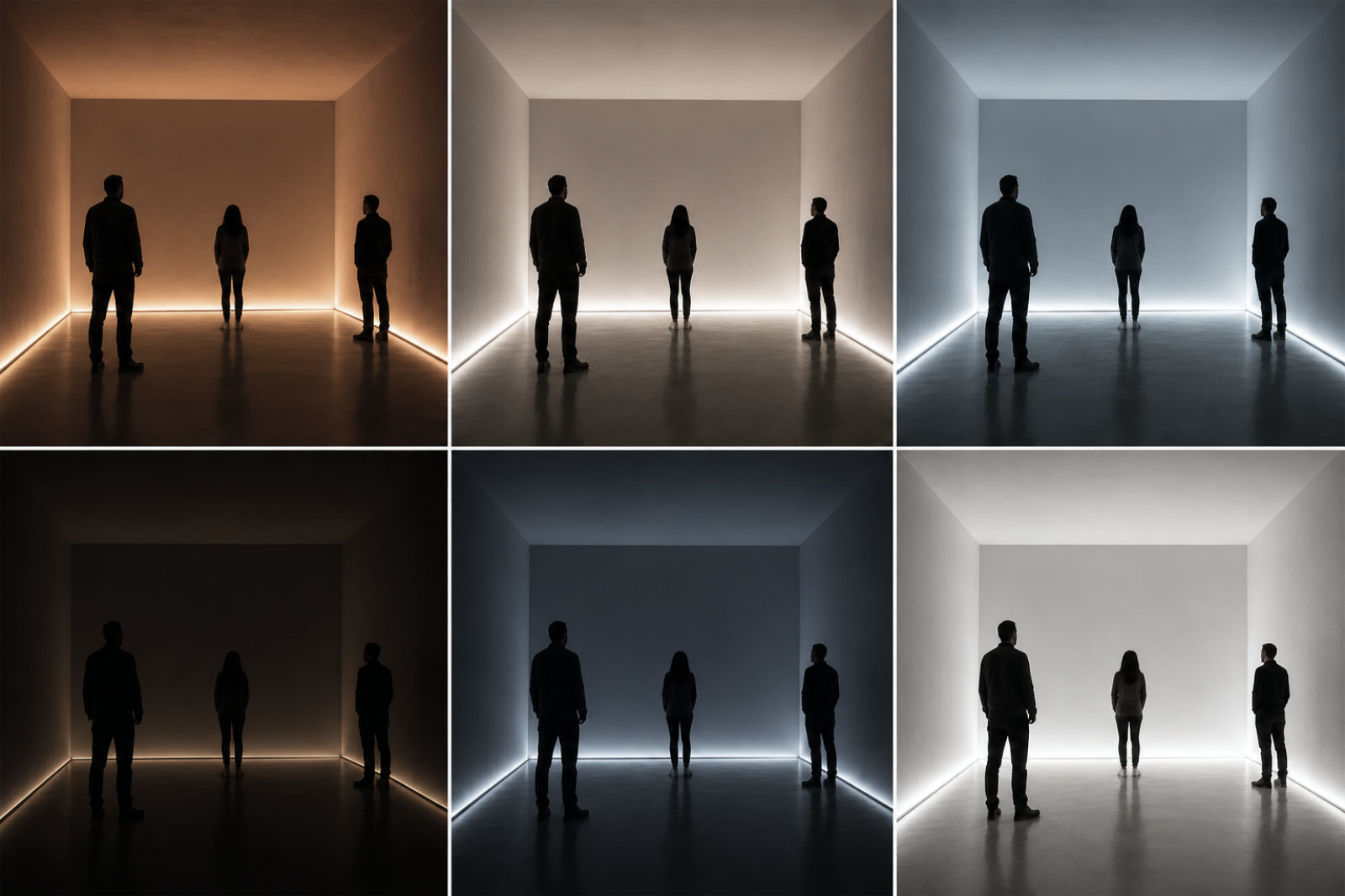
Operational Silence is a generative installation in which sound and light form a single, slowly evolving spatial system. Unlike interactive works that demand immediate engagement, the installation unfolds over time and moves through phases of condensation, disturbance, operational quietness, and release. The work does not present images, signals, or spectacle. Instead, it creates an emergent atmosphere through subtle shifts in brightness, gradual movements in sound, and almost imperceptible transitions that alter the perception of space itself. Sound and light are not treated as separate elements, but as two manifestations of the same underlying logic. What is heard and what is seen are different expressions of a shared internal process.
Emergence is central to the work. The system’s behavior is not predetermined, but develops through the interaction of its components. PitchMemory fills dynamically, ActivityLevel modulates energy, and states transition in response to presence. Visitors do not control the system; they influence it indirectly through their presence. These influences remain elusive, since the installation does not reveal its internal logic openly. Instead, it absorbs external conditions and transforms them into slow spatial modulations. The work behaves as a system with its own internal life, one that visitors inhabit rather than operate.
While Perpetuum Inefficiens examines economic systems as visible structures, Operational Silence focuses on algorithmic environments that shape perception in quieter and less visible ways. In a culture driven by visibility and immediate feedback, the work deliberately reduces itself to what is barely noticeable. It draws attention to processes that remain continuously active, yet rarely enter conscious perception.
This video shows a scaled spatial model of the installation, using original light and sound. The presence of visitors and their indirect influence on the system are not represented here.